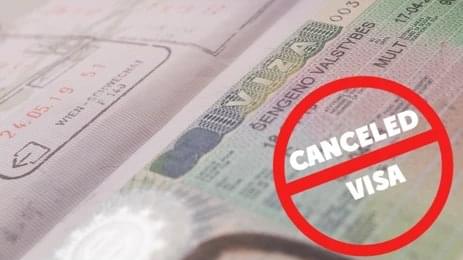
Many travellers believe a stamped Schengen visa guarantees entry. Under EU law, this assumption is legally incorrect. According to Eurostat data from 2024, about 10,235 people from third countries were turned away at EU external borders.
A Schengen visa does not provide an unconditional right to enter the Schengen Area, and you may still face Schengen visa cancellation even after approval.
However, two different legal systems decide the visa issuance and border entry refusal or approval. The EU Visa Code (Regulation 810/2009) governs how visas are assessed and issued by consulates, while the Schengen Borders Code (Regulation 2016/399) authorizes border officials to independently verify whether entry conditions are met at the time of arrival. Therefore, the authority can refuse entry to individuals who do not meet the requirements.
This guide uses EU legislation and Schengen visa compliance rules and government sources to explain your rights, obligations, and risks before travelling.
This guide references official European Union institutions and legal frameworks, including:
– European Commission (EC) — Policy authority for Schengen governance
– EU Visa Code (Regulation (EC) No 810/2009) — Visa issuance and revocation law
– Schengen Borders Code (Regulation (EU) 2016/399) — Entry conditions at external borders
– EUR-Lex (Official EU Law Database) — Source of binding legal texts
– Schengen Information System (SIS) — Security and refusal alert database
– Visa Information System (VIS) — Biometric and visa records platform
What Does Schengen Visa Cancellation Mean After Approval?
Schengen visa cancellation after approval refers to the formal legal process by which authorities cancel a visa that has already been issued and stamped in a passport. A visa refusal at the application stage is very distinct from this process. After getting a visa, it can only be revoked under strict legal conditions set by EU law, not at the applicant’s own choice.
According to Article 34 of the EU Visa Code (Regulation (EC) No 810/2009), there are two different ways to cancel a Schengen visa: annulment and revocation. Both are recognised ways to get your Schengen visa revoked, but they are used in different legal situations.
1. Annulment: When the Visa Should Never Have Been Issued
If the government finds that the visa was given in error, it can be revoked. According to Article 34(1), Member States must annul a visa if the required conditions were not met at the time of issuance.
Typical annulment scenarios include:
- Without a current travel medical policy that satisfies Article 15’s minimum coverage requirement of €30,000
- If the hotel bookings, employment letters, or financial proof were false or misleading from the start.
This means that the visa is legally null and void from the start.
2. Revocation: When Conditions Change After Issuance
Revocation applies when things change after the visa has already been issued. According to Article 34(2), authorities can revoke a visa if the conditions for issuance are no longer met or if document authenticity or applicant statements are questioned.
For example, if a business invitation was valid at the time of application but the inviting company later suspends operations before travel, the visa may be revoked because the declared travel purpose can no longer be verified.
Schengen Visa Invalidation: What It Means for Travellers
The term “invalidation” is not officially authorised. The EU Visa Code (Regulation (EC) No 810/2009) admits only two actions against an issued Schengen visa: annulment and revocation. Informally, travellers typically refer to one of these two measures as “invalidation.”
When Is “Invalidation” Applied in Practice?
This word is usually used when a visa is null and void after being revoked or annulled, usually at a consulate or border. It does not make a separate legal category.
How It Is Marked on the Visa?
Depending on the legal basis, visas are physically marked “ANNULLED” or “REVOKED.” There is no official “INVALIDATED” stamp under EU law.
Visa Revoked After Approval: Who Has the Authority?
EU law gives member state governments the power to revoke Schengen visas through consular, border, and security authorities. Article 34 of the EU Visa Code (Regulation (EC) No 810/2009) governs these powers and coordinates them through EU-wide information systems.
Consulates and Embassies
- The issuing Member State’s consulate or embassy is responsible for a Schengen visa revoked after approval.
- If new evidence of misrepresentation, fraud, or visa violation emerges, the Visa Code’s Article 34 allows the issuing authority to revoke the visa.
Border Control Authorities
Legally, border control officers are separate.
- They can refuse entry if you don’t meet the necessary entry criteria under Article 6 of the Schengen Borders Code (Regulation (EU) 2016/399).
Immigration and Security Agencies
- After entry, other Member State authorities, such as national security and immigration departments, may determine reasons for revocation.
- These authorities can request formal revocation and notify the issuing Member State if such grounds are found.
- The Schengen Information System (SIS) and the Visa Information System (VIS) enable this cross-border coordination to ensure visa compliance in all Schengen nations.
Timeline of Schengen Visa Revocation
- Before Travel- After approval but before departure, visas can be cancelled if post-issuance investigations reveal evidence of fraud, false statements, or security issues.
- During Transit—While in transit, alerts or database updates may cause authorities to intervene and prevent entry, potentially resulting in instructions to refuse entry at the next control point.
- At the Port of Entry- According to the Schengen Borders Code, your entry may be rejected at external borders, even if your visa is acceptable, if certain conditions are not met.
Can Border Officials Refuse Entry Even With an Approved Visa?
Yes, border officials can refuse your entry even if you have a Schengen Visa Approval. According to Article 6(1) of Regulation (EU) 2016/399 (Schengen Borders Code), third-country nationals must meet specific entry conditions for stays of up to 90 days in any 180 days. If any of these conditions are not met, border authorities may refuse entry – even if a visa has been issued.
- Valid Travel Document: You should have a travel document that is acceptable for at least three months after the planned departure date from the Schengen Area and issued within the last 10 years.
- Valid Visa or Residence Permit: Council Regulation (EC) No 539/2001 says that you must have a valid visa if you don’t already have a valid residence permit or long-stay visa; otherwise, you may experience border entry refusal.
- Justified Purpose and Conditions: You need to clearly state your objective (e.g., tourism, business, visiting family) of the visit. And you have adequate subsistence for the time of the stay.
- Sufficient Financial Means: Then you must have proper money to cover all expenses during your stay and return to the main country or transit through third countries.
No SIS Alert: If any person gets an alert from the Schengen Information System (SIS), then their visa can be denied.
No Threat to Public Order: You should not be considered as a threat to any Schengen Member State’s public policy, internal security, public health, or relationships with other countries.
Let’s Understand the Real-Time Border Scenarios You May Face Even After Visa Approval
Here, I will give you three real scenarios that you may face as a reason for Schengen visa invalidation-
Scenario 1: Insufficient Financial Means
Suppose you stated that you have €1,000 for a 10-day tourist visit to France. Additionally, you submitted your bank statements, which confirm that you have this amount. But border officers ask for proof that you have enough money. You only bring €200 in cash and no credit cards or other proof of your identity.
Even with a valid visa, you were denied entry under Article 6(1)(c) because you couldn’t prove you had enough money to live on.
Scenario 2: Expired or Invalid Supporting Documentation
if you sent in a letter from a business partner in Germany inviting you to a conference in two months. And when the border officer verifies this invitation, and it gets cancelled, then you may have visa revocation under Article 34(2).
Scenario 3: Travel Insurance Gaps
According to Article 15 of Regulation (EC) No 810/2009 (EU Visa Code), you have bought travel medical insurance that covers at least €30,000 and is valid for the duration of your visa. However, your insurance ran out yesterday, and your trip starts today. So be careful about this insurance’s validity and plan your travel accordingly.
Schengen Visa Compliance Rules Travellers Must Follow (With 2025–2026 Official Updates)
A visa or residence permit does not guarantee entry; the border officers will check and verify all documents. You can see these recent updates on visa compliance rules to ensure you have all the necessary information before travelling.
Entry/Exit System (EES)—Digital Border Control
There will be digital records of entries and exits, including biometric data like fingerprints and facial images, instead of stamps in passports, scheduled on October 12, 2025. EES will be fully operational by April 10, 2026. It will allow the government to automatically monitor visa overstayers and enforce the 90- or 180-day short-stay rule.
European Travel Information and Authorization System (ETIAS)
The ETIAS is a required pre-travel authorisation for visa-exempt citizens and will be comparable to the U.S. ESTA. The system is not currently operational, and no applications for travel authorisations are being collected; however, it is scheduled to be implemented in the final quarter of 2026. Moreover, you need to pay an online application fee (EUR 20), but you will check entry requirements at the border.
These technological and regulatory changes require you to get ready for biometric checks before and at the border. Moreover, the border authorities will take the final entry decisions.
How Airlines and Transit Countries Can Impact Your Schengen Entry?
However, airline and transit country compliance rules are very important to know.
- Airline compliance verification begins before boarding. Airlines are responsible for returning passengers refused entry under IATA regulations. At your departure airport, airline staff will check your documentation.
- Transit visas are needed in Schengen Area transit countries. Your nationality may require transit authorisation for London, Moscow, or Dubai if your flight to Paris passes through those countries. These are necessary even if you never leave the airport’s international transit area.
- The verification of return tickets is another airline checkpoint. They worry about liability and the target country’s immigration laws. Airlines often require proof of return travel before issuing boarding passes for one-way Schengen Area tickets.
What To Do If Your Schengen Visa Is Cancelled or Revoked?
When you know that your Schengen visa has been cancelled or revoked, you should inspect it from scratch, like this:
- First, you need to understand the specific reasons for cancellation. So you should carefully review the official notification. Member States will give you a written notice that identifies the particular legal basis. It should clearly state which conditions you supposedly failed to meet and indicate whether the decision is one of revocation (the circumstances have changed) or annulment (the visa should not have been issued).
- If your Schengen visa is unlawfully revoked, you can file an appeal. A cancellation notice must state the appeal process, deadline, and responsible party. Timing for appeals usually falls between 30 and 60 days(For example, Italy allows 60 days, while the Czech Republic only allows 15 days), though it can vary by member state. Your appeal should address the cancellation grounds and show legal compliance.
- Moreover, you need to keep all related documents, including your original visa application, supporting evidence, cancellation notice, and official messages. These proofs are important for visa applications and hearings.
- For the complicated cases, you can take help from immigration lawyers who know Schengen law. It is important when you have language barriers and mismatches of laws.
How Do Professional Visa Compliance Checks Reduce Risk?
If you want to avoid visa cancellation after approval, you need to verify these factors continuously-
- You should have a planned pre-travel compliance check to identify risks at an early phase.
- You can gather all verified documents as per current EU regulations and member-state-specific requirements. It will help you to reduce the risk of visa cancellation or invalidation.
- Also, you have to recheck that your visa date and medical insurance are aligned, financial proof, accommodation bookings, and invitation letters are all updated.
- Your itinerary should be consistent, like your intended length of stay, purpose of visit, and scheduled activities.
- Then you need to prepare yourself for interviews at BLS and VFS. These are official centres for applying for a Schengen visa in certain areas.
Final Takeways
After getting the Schengen Visa, you can face visa cancellation. If you do not prepare your documents, travel insurance, itinerary, and hotel accommodations, you can face border refusals. Though you can also reapply and question why you get invalidation or revocation if you feel it is unlawful. But it takes time to solve.
However, if you take any professional visa assistance, it will help you to avoid missing any important details. So you can take help from Schengen Travel Agency. We make it easy to obtain a visa for Schengen, the UAE, and other countries. We have our presence in the UAE, the UK, Saudi Arabia, the Philippines, Kazakhstan, Oman, and Qatar, and we have over ten years of experience. We provide visa compliance and documentation assistance across the United Kingdom: London, Birmingham, and Manchester.
We can make your visa application process easy, but we don’t guarantee you the visa because the grant of a visa is decided by the respective embassy or consulate.
FAQ
Can a Schengen visa be cancelled without notice?
According to EU law, authorities can cancel your visa for security, fraud, or eligibility reasons. They also have to give a written explanation after that.
Does visa cancellation affect future approvals?
Yes. A cancellation is recorded in EU systems, and future Schengen visa applications may be impacted.
What happens if I’m refused entry at the border?
You will receive a formal decision of refusal, which is recorded in EU border control systems and may be sent back.
Can I appeal a Schengen visa revocation?
Yes. You can file an appeal with the issuing Member State within specific time limits, typically 30 to 60 days.
How can I avoid Schengen visa issues after approval?
You need to keep all your official documents up to date. Moreover, you should plan your itinerary according to the country you’re applying for a visa for, and then have adequate funds to show the border officer. Medical insurance is also important. Then you must follow the border security rules and update yourself with the new visa rules and regulations.